Pages

Friday, July 24, 2015

It's Been Real Y'all

This week went by FAST. I only came in to the office twice, because every other day I was doing training at my new job. I thought having a bachelor's degree would save me from menial retail work, but I was wrong--that's for another blogpost though.

*Hopes master's degree will save me from this life *
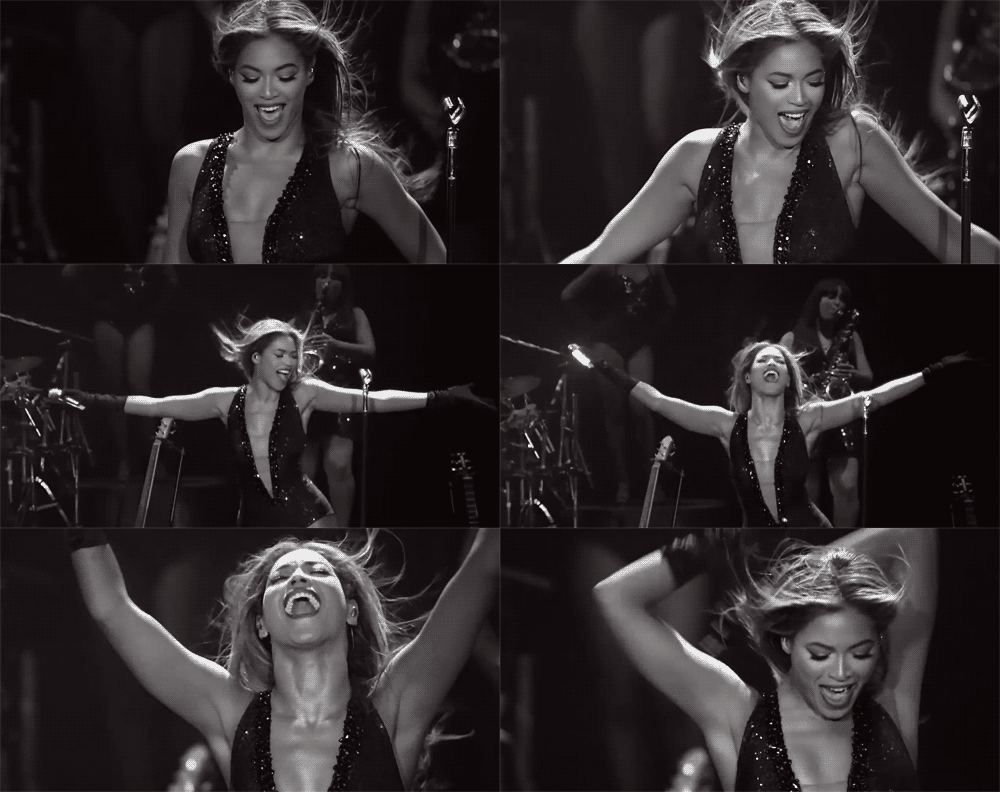
This exhibit is practically done, the essay is (kinda-sorta-no-not really) done, and most importantly I FINALLY KNOW HOW TO WRITE METADATA. Yes, you read that correctly. I, Porsha Ra'Chelle Dossie have finally become the Beyonce Giselle Knowles-Carter of Metadata. It only took me about ten weeks or so, but Beyonce wasn't perfected in a day, so why should I be perfect at metadata the first time?

But no, really on a serious note, I am so glad that I feel more confident about writing metadata. This internship became a huge challenge for me and caused me to question if history was the field I belonged in. It really shook my confidence in myself. But ten weeks later and I am finally able to say that I can efficiently write metadata and curate it into a digital collection.


Me when I finally figured out how to write metadata


Shoutout to Dr. French for being so helpful and awesome, I don't know where I'd be without your encouragement (and the cool blogs you link me too)! Another shoutout goes to the podcast app on my phone for helping me get through the long hours of writing, and the final shoutout goes to the people of Oviedo who brought their items to be scanned and digitized, because without them I would not have an internship and would have to start paying back Sallie Mae all the money she loaned me and I ain't go it! So, yeah. 

This is me. 
I've learned a lot about myself as a person, but more importantly as a historian in the making. This experience has left an indelible mark in my graduate career and I hope to build on it from here.

It's been real guys.

Thanks for reading,

Porsha 


Friday, July 17, 2015

The Penultimate Post

I can't believe this is my second to last blog post for this internship. This summer went by so fast. School is right around the corner (ugh), and with my new job starting this upcoming week, and me moving out of my apartment in less than two week, let's just say I'm going to be pretty busy. But I'll be fine....right?

I have never felt more spiritually connected to something in my life.
Source


I had training this week, so I only went into the RICHES office Monday and then today, Friday.

Thanks to Laura and Dr. Lester, the items I needed for the exhibit are up on RICHES as we speak and I was able to work on the exhibit. I still have one item left, which is an oral history that I spent most of today transcribing. I'll finish it up Monday, including writing the metadata. I still have a good amount of items that need metadata, but I have to be realistic and know that I may not be able to finish it all and that is ok. I'm not a failure (repeats as a mantra to get through this internship/grad school).

My main focus will now be the finishing up the exhibit and the paper. I'm not sure when my presentation is, but the way this month is going, I'm sure it will be on a day where I have to move out of my apartment/go to work/everything that's ever been due is due right then, because that is my life. Being a semi-adult is hard.

This gifset deal also does a great job at describing grad school
Source: Buzzfeed
Next week I'll wrap up this blog with some poignant, millenial-ish insight that will be (obviously) hysterical, but also extremely heart-wrenching and profound.

It'll mostly just be gifs.

Porsha

Friday, July 10, 2015

Invisible History: Black Life in Oviedo, Florida

The above headline is the working title of my exhibit for the RICHES Mosaic Interface. I've chosen to feature digitized items that explore the lived experiences of African-Americans in Oviedo. Oviedo's local history has been sanitized (read: WHITEWASHED), most likely for a myriad of reasons. For much of it's history it was a small farming community nestled south of Lake Jesup and eclipsed by the more populous and urban Sanford to its north. Much of its history was documented by Oviedo's founding families and later collected by individuals who took a strong interest in preserving the town's history once UCF-- then Florida Technological University-- was built on the outskirts of the town during the 1960s, irrevocably changing Oviedo and the course of its history.

Nice going, UCF


I'm from Miami and I like to let everybody know it because let's face it, it's probably the only place in Florida that's relatively normal (NOBODY MENTION THE TIME THAT GUY ATE A HOMELESS MAN'S FACE ON THE MACARTHUR CAUSEWAY IN NORTH MIAMI IT WAS ONE TIME GUYS ONE TIME), but Central Florida has a rich history that is relegated to the background in favor of theme parks and other tourist attractions. ALL of Florida is much more than Disney World and the strip clubs on South Beach--though I would for love someone to write a history of King of Diamonds in the next decade or so but they may just be me--and much of its local history has been rendered invisible as local figures and occurrences remain just that---local.

Can you imagine a feminist discourse on black strip club culture in the American South? Have I just figure out my topic for my master's thesis ???
That's the beauty of History Harvests and sites like RICHES which make these "invisible histories" accessible to a wider audience. That's where metadata becomes crucial (Thanks Dr. French for helping me figure that out!). Without metadata how would people be able to find these items? ANSWER: They wouldn't.

So as I continue to work on my exhibit (and try to finish up the rest of this metadata and write that paper and not collapse from exhaustion lulz), I'm trying to keep in mind that it was through curating the metadata for this collection that I was able to learn that Oviedo had a long and storied past of African-Americans carving out a community for themselves after the Civil War and through the Jim Crow era. They fought for better schools for their children and once denied that, they raised funds to create their own. When denied entry into local business they integrated them during the 1960s through acts of civil disobedience. Stories such as these are hidden all over the United States and it's honor to help make them part of a larger narrative of African-American endurance in the face racial oppression.

Friday, July 3, 2015

So About This Paper...

Welcome back! As promised last week, this blogpost will be about my topic for the historiographical component of my internship. It's still slightly fuzzy, which I am going to partially (lol jk mostly) blame on the fact that I have never taken a graduate level historiography class. Lucky for me when I started in the Spring semester I only had to write one historiography paper. I don't know what I got on it, but I do know that I didn't fail the class so I'm going to say B- maybe?

Anyway, once I take historiography in the Fall I should get a better grip on in it, or at the very least feel more confident about writing those types of papers.

everything I've ever written in grad school tbh

Since anyone reading this blog is well aware of my disdain for metadata, I am choosing to focus more on History Harvests, however much of the essay will discuss metadata harvesting in digital archives. Developed by the Open Archives Institute, the Open Archives Initiative Protocol for Metadata Harvesting (OAI-PMH) is used to collect metadata from various archives in order to build services that would allow users to search for and discover archival resources. Because History Harvests are very localized in construction, providing wider access to a collection without interfering with the shared authority of the community the items originated from is of extreme importance. I believe the field is heading in the direction of creating platforms where this will soon be a reality.

I will also discuss the preservation of the physical items that were digitized. Most of these items are not kept in the best conditions (in attics, garages, etc.). What locals seems to enjoy most about the Harvests  are sharing the items, but also getting them back after they have been scanned. While some may be inclined to donate, not everyone will be as interested in doing the same. How can historians make sure that these physical items are preserved; or rather, as some believe, is the digital copy is more than enough?

I will include case studies of digital archival projects and the role of metadata in their functioning. As I am interning for RICHES I will definitely include a examination of their growing History Harvest collection.

Another thing I could explore is how are people coming together and using metadata to document ongoing current events for posterity. This would include social movements, controversial histories, etc.

So that's all I got for now. The paper is fast approaching, and I still have a digital exhibit to curate.

me right now


Until next week!

Porsha

Friday, June 26, 2015

What I Listen to While I'm Curating Metadata

Last week's post was a little bleak. I apologize. I thought it would be good to lighten this one up with some tunes! And some podcasts! I've really been into podcasts that last two or so years, and I mainly listen to them when I'm cooking, cleaning, or on long trips back home. I never knew they would be so helpful when it comes to writing metadata. They make time go by so much faster, and works as nice background noise which weirdly helps me to concentrate. 

Also this week, I was able to get some help (thanks Dr. French!) concerning that 15-20 page paper that's fast apporaching, and now I have a better idea of what my topic is going to focus on. I'm going to keep reading and write back next week exactly what the paper will be on. I'm sure you will all be waiting with bated breath.

Without further ado here's some of my favorite podcasts to listen to while curating metadata (and a song or two).


1. The Read


Pop culture, love advice, and a lot of laughs from two queer people of color. The title of the podcast comes from 1980s New York ball culture slang "to read" or reading. Here's Dorian Corey explaining the difference reading and shade from the famous documentary by Jennie Livingston Paris Is Burning. Seeing as shade has come into mainstream prominence, this video is defintiely necessary for those you wondering if you're using "throwing shade" incorrectly. Hint: you probably are.

2. Another Round

One of Buzzfeed's podcasts, Another Round features Heben Nigatu and Tracy Clayton who talk systemic racism, their hatred of New York City squirrels, and pop culture with visiting guests such as J. Smoove, Issa Rae, and Roxanne Gay.

3. Mmhmm, Girl

Lola and Babs are two Bay Area girls who dish about celebrity gossip, current events, pop culture, sexuality and the like. They leave no stone unturned and are not afraid to go there. I usually have to refrain from busting out laughing while I'm in the office anytime I Iisten to their podcast. 10/10 would recommend. 

Songs:

1. I Knew You Were Trouble Jersey Club Mix

2. We Are Young Jersey Club Mix

So that's it. That's what I've been listening to these past few weeks. Any suggestions?

See you next week!


Friday, June 19, 2015

I'm Not Exactly Meta about Metadata

This week, like last week, and the week before that, was—as usual—really tedious and underwhelming. It becomes increasingly difficult to find ways to cope with an internship that as it turns out, isn’t the best fit for you. I obviously knew this coming into it, but I was honestly just grateful to have internship after the others  fell through at the end of the last semester. I took out a loan to go to grad school, and Sallie Mae definitely told me herself that if for any reason I wasn’t enrolled in a certain number of credits a semester she would ask for all her coins back, which, uh, I don’t have.


So to avoid that I thought it would be cool to continue with the Oviedo History Harvest project, seeing it through to the (digitized) end. But I also wanted to develop practical skills. Now that I’m entering the adult world—eek, do I count as an adult? Quarter life crisis ensuing in 3…2….1— I feel that its important for me to have skills that aren’t just reading and writing. How does that differentiate me from anybody else in my program or any other History graduate programs across the United States. We can all read and write and think critically. That’s why were in grad school. What can I offer, what skills do I have that will make me marketable so that I can have a career that doesn’t involve wearing an itchy uniform and asking people if they want to try our new double-stuffed Oreo McFlurry? 


Listen, my family doesn’t exactly believe in failure. There is no doubt, an ulcer forming in stomach because of it. Also a lot of general anxiety disorder and a little OCD thrown in for good measure. I say all of this to say that curating metadata brings up a lot of my anxities, fear of failure being one of them. If I mess this up—and fail this internship in the process—RICHES will probably find another intern to fix it up, no biggie. But, it really stresses me out that I can’t seem to get the hang of this or the reading material. What does that say about me as an student? Am I even cut out to be an historian?

I think a huge issue here is that curating metadata doesn’t stimulate me. Being in front of a computer doing repetitive work never came to mind when I thought about what I would do as an historian—writing monographs aside—but I knew there would be times where I would have to do things that I didn’t like. That’s a part of life obviously. Everybody does things they don’t like. That’s ok. 

So what do I want to do as an historian? I want to challenge people; make them uncomfortable. I want to make someone reassess everything they think they know about history and to question it. But most importantly I want to help make a difference. I’m totally an annoying social justice warrior.  When I think about the first internship I had planned to do—and will hopefully do eventually—I think about the opportunity I had to help people who would otherwise not be able to save and preserve their church. It’s these real world connections that drew me to public history, not theory and rhetoric.

 I think about what’s happened in Charleston, what continues to happen every day in this country where people who look like me are gunned down by police and average citizen alike, with no retribution. Where does metadata fit into that? Where is my connection? 

Sorry for the depressing post. This week was rough. 

Porsha 

Friday, June 12, 2015

Curating Metadata as Told Through Nene Leakes Gifs

Welcome back to the ongoing struggle that is me curating metadata. In this week's installment I'm going to discuss some of the material Dr. French was kind enough to send to me (THANK YOU!!!). It's cleared up some of my confusion when it comes to certain aspects of metadata, but it's also raised some questions. Within the context of historical scholarship assessing data, as well as the data that explains said data, i.e. metadata, warrants its own scholarships and typology in order to categorize and understand it. This allows historians to better review and assess the effectiveness of digital works.

Professor William Thomas created a chart that I feel can explain this much better than I can :The Chart

Working in the digital realm allows historians to create a number of deliverables that can range from interactive websites to a simple Youtube video. Evaluating these projects is the focus of much digital scholarship because the digital can create new forms of inquiry that were once unthinkable before the advent of 21st century technology.

Disseminating this information to those who are outside the field of digital humanities is also a major objective. But based on the amount of technical terminology that the field uses, that's definitely going to be difficult, because some of these articles read like a physics textbook--which I just barely passed in undergrad, And like me, most people who choose history as their profession, math and science? Not exactly our forte.

But I'm just gonna keep on trucking through this digital history thing. If I can't be the Beyonce of Metadata I can at least be Rihanna. Or Nicki Minaj. Anybody but Keri Hilson.


So, this week I worked on about 4 Microsoft Excel spreadsheets of metadata. And all of them were wrong.

 So as I'm redoing the metadata sheets, the computer I'm working on decides to update. And what I mean by update is exit out of everything I've worked on and shut down completely.


Luckily, Windows did not forsake me for being a Mac user and autosaved my work.


 But then I found out I still had more metadata sheets to fix. 


When the computer freezes and so I can't redo the data sheets.


When the computer starts working again, but now google maps won't let me get the coordinates for the GeoChrons tab on the excel sheet.


When I finally get the coordinates I need, but now there's not enough information on the item I'm writing metadata for in a book or online so my description tab isn't descriptive enough.


When I finally complete a sheet and its mostly correct. 

But then I remember I have thousands of digitized items I still have to write metadata for in less than a month and a half.


Until next week.