Pages

Friday, July 24, 2015

It's Been Real Y'all

This week went by FAST. I only came in to the office twice, because every other day I was doing training at my new job. I thought having a bachelor's degree would save me from menial retail work, but I was wrong--that's for another blogpost though.

*Hopes master's degree will save me from this life *
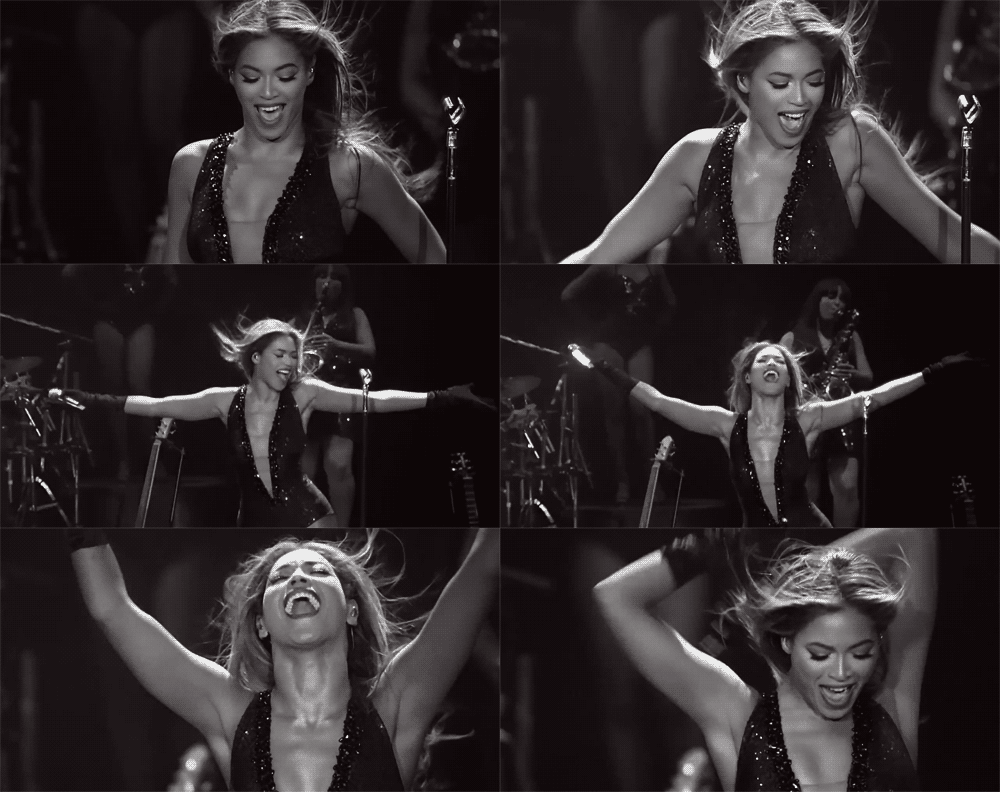
This exhibit is practically done, the essay is (kinda-sorta-no-not really) done, and most importantly I FINALLY KNOW HOW TO WRITE METADATA. Yes, you read that correctly. I, Porsha Ra'Chelle Dossie have finally become the Beyonce Giselle Knowles-Carter of Metadata. It only took me about ten weeks or so, but Beyonce wasn't perfected in a day, so why should I be perfect at metadata the first time?

But no, really on a serious note, I am so glad that I feel more confident about writing metadata. This internship became a huge challenge for me and caused me to question if history was the field I belonged in. It really shook my confidence in myself. But ten weeks later and I am finally able to say that I can efficiently write metadata and curate it into a digital collection.


Me when I finally figured out how to write metadata


Shoutout to Dr. French for being so helpful and awesome, I don't know where I'd be without your encouragement (and the cool blogs you link me too)! Another shoutout goes to the podcast app on my phone for helping me get through the long hours of writing, and the final shoutout goes to the people of Oviedo who brought their items to be scanned and digitized, because without them I would not have an internship and would have to start paying back Sallie Mae all the money she loaned me and I ain't go it! So, yeah. 

This is me. 
I've learned a lot about myself as a person, but more importantly as a historian in the making. This experience has left an indelible mark in my graduate career and I hope to build on it from here.

It's been real guys.

Thanks for reading,

Porsha 


Friday, July 17, 2015

The Penultimate Post

I can't believe this is my second to last blog post for this internship. This summer went by so fast. School is right around the corner (ugh), and with my new job starting this upcoming week, and me moving out of my apartment in less than two week, let's just say I'm going to be pretty busy. But I'll be fine....right?

I have never felt more spiritually connected to something in my life.
Source


I had training this week, so I only went into the RICHES office Monday and then today, Friday.

Thanks to Laura and Dr. Lester, the items I needed for the exhibit are up on RICHES as we speak and I was able to work on the exhibit. I still have one item left, which is an oral history that I spent most of today transcribing. I'll finish it up Monday, including writing the metadata. I still have a good amount of items that need metadata, but I have to be realistic and know that I may not be able to finish it all and that is ok. I'm not a failure (repeats as a mantra to get through this internship/grad school).

My main focus will now be the finishing up the exhibit and the paper. I'm not sure when my presentation is, but the way this month is going, I'm sure it will be on a day where I have to move out of my apartment/go to work/everything that's ever been due is due right then, because that is my life. Being a semi-adult is hard.

This gifset deal also does a great job at describing grad school
Source: Buzzfeed
Next week I'll wrap up this blog with some poignant, millenial-ish insight that will be (obviously) hysterical, but also extremely heart-wrenching and profound.

It'll mostly just be gifs.

Porsha

Friday, July 10, 2015

Invisible History: Black Life in Oviedo, Florida

The above headline is the working title of my exhibit for the RICHES Mosaic Interface. I've chosen to feature digitized items that explore the lived experiences of African-Americans in Oviedo. Oviedo's local history has been sanitized (read: WHITEWASHED), most likely for a myriad of reasons. For much of it's history it was a small farming community nestled south of Lake Jesup and eclipsed by the more populous and urban Sanford to its north. Much of its history was documented by Oviedo's founding families and later collected by individuals who took a strong interest in preserving the town's history once UCF-- then Florida Technological University-- was built on the outskirts of the town during the 1960s, irrevocably changing Oviedo and the course of its history.

Nice going, UCF


I'm from Miami and I like to let everybody know it because let's face it, it's probably the only place in Florida that's relatively normal (NOBODY MENTION THE TIME THAT GUY ATE A HOMELESS MAN'S FACE ON THE MACARTHUR CAUSEWAY IN NORTH MIAMI IT WAS ONE TIME GUYS ONE TIME), but Central Florida has a rich history that is relegated to the background in favor of theme parks and other tourist attractions. ALL of Florida is much more than Disney World and the strip clubs on South Beach--though I would for love someone to write a history of King of Diamonds in the next decade or so but they may just be me--and much of its local history has been rendered invisible as local figures and occurrences remain just that---local.

Can you imagine a feminist discourse on black strip club culture in the American South? Have I just figure out my topic for my master's thesis ???
That's the beauty of History Harvests and sites like RICHES which make these "invisible histories" accessible to a wider audience. That's where metadata becomes crucial (Thanks Dr. French for helping me figure that out!). Without metadata how would people be able to find these items? ANSWER: They wouldn't.

So as I continue to work on my exhibit (and try to finish up the rest of this metadata and write that paper and not collapse from exhaustion lulz), I'm trying to keep in mind that it was through curating the metadata for this collection that I was able to learn that Oviedo had a long and storied past of African-Americans carving out a community for themselves after the Civil War and through the Jim Crow era. They fought for better schools for their children and once denied that, they raised funds to create their own. When denied entry into local business they integrated them during the 1960s through acts of civil disobedience. Stories such as these are hidden all over the United States and it's honor to help make them part of a larger narrative of African-American endurance in the face racial oppression.

Friday, July 3, 2015

So About This Paper...

Welcome back! As promised last week, this blogpost will be about my topic for the historiographical component of my internship. It's still slightly fuzzy, which I am going to partially (lol jk mostly) blame on the fact that I have never taken a graduate level historiography class. Lucky for me when I started in the Spring semester I only had to write one historiography paper. I don't know what I got on it, but I do know that I didn't fail the class so I'm going to say B- maybe?

Anyway, once I take historiography in the Fall I should get a better grip on in it, or at the very least feel more confident about writing those types of papers.

everything I've ever written in grad school tbh

Since anyone reading this blog is well aware of my disdain for metadata, I am choosing to focus more on History Harvests, however much of the essay will discuss metadata harvesting in digital archives. Developed by the Open Archives Institute, the Open Archives Initiative Protocol for Metadata Harvesting (OAI-PMH) is used to collect metadata from various archives in order to build services that would allow users to search for and discover archival resources. Because History Harvests are very localized in construction, providing wider access to a collection without interfering with the shared authority of the community the items originated from is of extreme importance. I believe the field is heading in the direction of creating platforms where this will soon be a reality.

I will also discuss the preservation of the physical items that were digitized. Most of these items are not kept in the best conditions (in attics, garages, etc.). What locals seems to enjoy most about the Harvests  are sharing the items, but also getting them back after they have been scanned. While some may be inclined to donate, not everyone will be as interested in doing the same. How can historians make sure that these physical items are preserved; or rather, as some believe, is the digital copy is more than enough?

I will include case studies of digital archival projects and the role of metadata in their functioning. As I am interning for RICHES I will definitely include a examination of their growing History Harvest collection.

Another thing I could explore is how are people coming together and using metadata to document ongoing current events for posterity. This would include social movements, controversial histories, etc.

So that's all I got for now. The paper is fast approaching, and I still have a digital exhibit to curate.

me right now


Until next week!

Porsha